Bible Exegesis Pdf
Posted : admin On 25.05.2020Genesis Standards. Red Tractor. Nsf quality audit.
Training SummaryAn Ethical Hacker exposes vulnerabilities in software to help business owners fix those security holes before a malicious hacker discovers them. What should I know?Nothing! In this course, you learn all about Ethical hacking with loads of live hacking examples to make the subject matter clear. Learn ethical hacking online free in hindi.
- Bible Exegesis Definition
- Bible Exegesis Pdf Download
- Biblical Commentaries Pdf
- Bible Exegesis Pdf Template
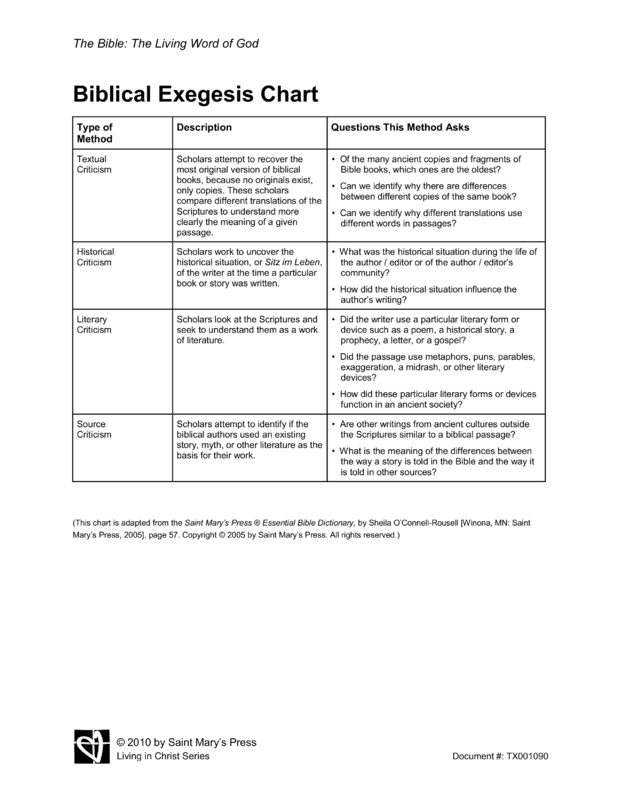
Guide for Writing an Exegesis On a Biblical Passage A. Initial Approach 1. Locate your pericope both within the immediate context of the basic division of the book and the overall structural units of the book. You may have to read a couple of chapters to get the sense of the functions of the pericope in the wider unit. Look for key words. Studying the Bible in-depth can be a daunting task. The following steps developed by Dr. Rebecca Idestrom (Associate Professor of Old Testament at Tyndale Seminary) are designed to help you engage the Scriptures responsibly and thoughtfully. Biblical interpretation and exegesis are skills developed over time, so don’t be discouraged if you. The basics of understanding Bible Study methods, how to learn from and about God's Word is basically simple, do it. But what we do not want to do is do it bad or erroneous. The science and art of exegesis or exegetical method is not meant to be scary, but rather provide us with the essential tools so we can better know and teach His Word.
Question: 'What is good biblical exegesis?'Answer: Exegesis means “exposition or explanation.” Biblical exegesis involves the examination of a particular text of scripture in order to properly interpret it. Exegesis is a part of the process of hermeneutics, the science of interpretation. A person who practices exegesis is called an exegete.
Good biblical exegesis is actually commanded in scripture. “Study [be diligent] to show thyself approved unto God, a workman that needeth not to be ashamed, rightly dividing the word of truth” (2 Timothy 2:15). According to this verse, we must handle the Word of God properly, through diligent study. If we don’t, we have reason to be ashamed.
There are some basic principles of good exegesis which serious students of the Bible will follow:
1. The Grammatical Principle. The Bible was written in human language, and language has a certain structure and follows certain rules. Therefore, we must interpret the Bible in a manner consistent with the basic rules of language.
Usually, the exegete starts his examination of a passage by defining the words in it. Definitions are basic to understanding the passage as a whole, and it is important that the words be defined according to their original intent and not according to modern usage. To ensure accuracy, the exegete uses a precise English translation and Greek and Hebrew dictionaries.
Next, the exegete examines the syntax, or the grammatical relationships of the words in the passage. He finds parallels, he determines which ideas are primary and which are subordinate, and he discovers actions, subjects, and their modifiers. He may even diagram a verse or two.
2. The Literal Principle. We assume that each word in a passage has a normal, literal meaning, unless there is good reason to view it as a figure of speech. The exegete does not go out of his way to spiritualize or allegorize. Words mean what words mean.
So, if the Bible mentions a “horse,” it means “a horse.” When the Bible speaks of the Promised Land, it means a literal land given to Israel and should not be interpreted as a reference to heaven.
3. The Historical Principle. As time passes, culture changes, points of view change, language changes. We must guard against interpreting scripture according to how our culture views things; we must always place scripture in its historical context.
The diligent Bible student will consider the geography, the customs, the current events, and even the politics of the time when a passage was written. An understanding of ancient Jewish culture can greatly aid an understanding of scripture. To do his research, the exegete will use Bible dictionaries, commentaries, and books on history.
Bible Exegesis Definition
4. The Synthesis Principle. The best interpreter of scripture is scripture itself. We must examine a passage in relation to its immediate context (the verses surrounding it), its wider context (the book it’s found in), and its complete context (the Bible as a whole). The Bible does not contradict itself. Any theological statement in one verse can and should be harmonized with theological statements in other parts of scripture. Good Bible interpretation relates any one passage to the total content of scripture.Bible Exegesis Pdf Download
Biblical Commentaries Pdf
5. The Practical Principle. Once we’ve properly examined the passage to understand its meaning, we have the responsibility to apply it to our own lives. To “rightly divide the word of truth” is more than an intellectual exercise; it is a life-changing event.